

North West Area Group Report
North West Area Group - Planned Events 2013
Update: Feb 1
L&B Talk in South Manchester/Cheshire - Friday 8th Feb 2013
2012 Events
Bob Barnard will give his talk on "The L&B Then and Now", for the Manchester Locomotive Society on Friday 17 Aug 2012 at 7.30 - 21.15. The meeting will take place in the MLS room at Stockport Station. Their secretary is John Owen on 0161 432 4073, or contact Bob for details of the venue.
A Grand Day Out
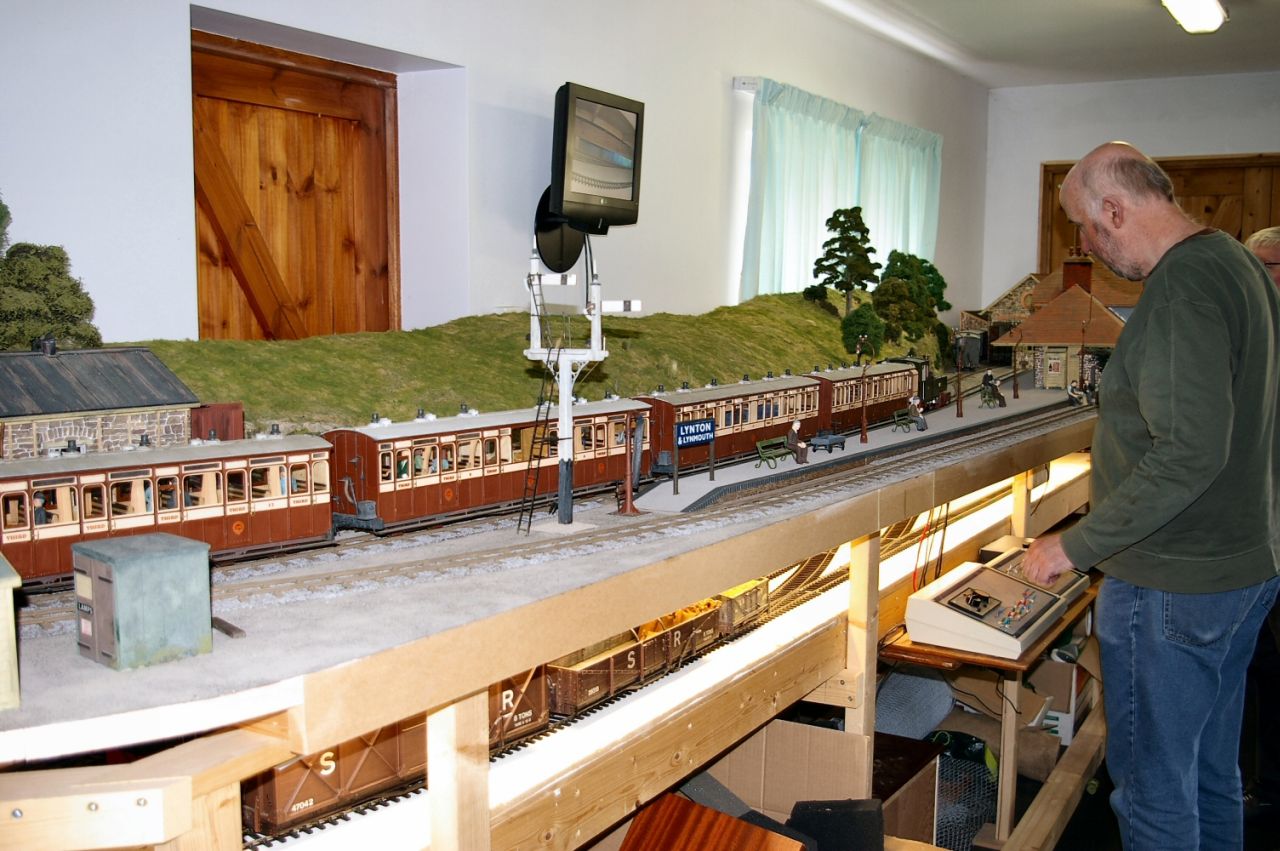
Henry Holdsworth's layout was built to the large scale of 16mm/1ft, more commonly associated with live steam garden railways, but in this case was electric, and housed in a 32ft x 16ft building at his home in Yorkshire.
At a show some years ago, L&B Member and narrow gauge enthusiast Chris Walker had revealed that he had acquired some of the locomotives, much of the rolling stock and the buildings and structures from Lynbridge after Henry Holdsworth’s death, other items being retained by the Holdsworth family.
Chris was starting to reconstruct Lynbridge (based closely on Lynton station) in a large outbuilding at his home. Now, we were invited to inspect progress.
Chris and fellow model-maker David Smith demonstrated and operated the rebuilt layout for us. The baseboards and track are new, whilst Henry Holdsworth’s original buildings and his Lancey Brook viaduct have been re-installed, and scenery at Lynton station is well-advanced. Holdsworth’s professionally-built model of Exe has been rebuilt and is joined by Chris’s own model of Yeo. Holdsworth’s Lyn has been stripped down ready for rebuilding. It is good to know that such magnificent models are in safe hands.
A fully scenic model railway in this scale is truly impressive, but also very time-consuming to build. Holdsworth’s L&B rolling stock is wonderful, some items carrying L&B livery, others Southern. The L&B theme of our visit was continued by a 3½” Gauge “Lew”, being finished with fantastic attention to detail by Stuart Daw, who had delivered it the previous day, just for us to see. Bob Barnard also brought his working model of Pilton Signalbox.

Henry Holdsworth's model of "Exe"

A general view of Lynton station, with fiddle yard beneath. Stuart Daw's "Lew" is visible on the right.
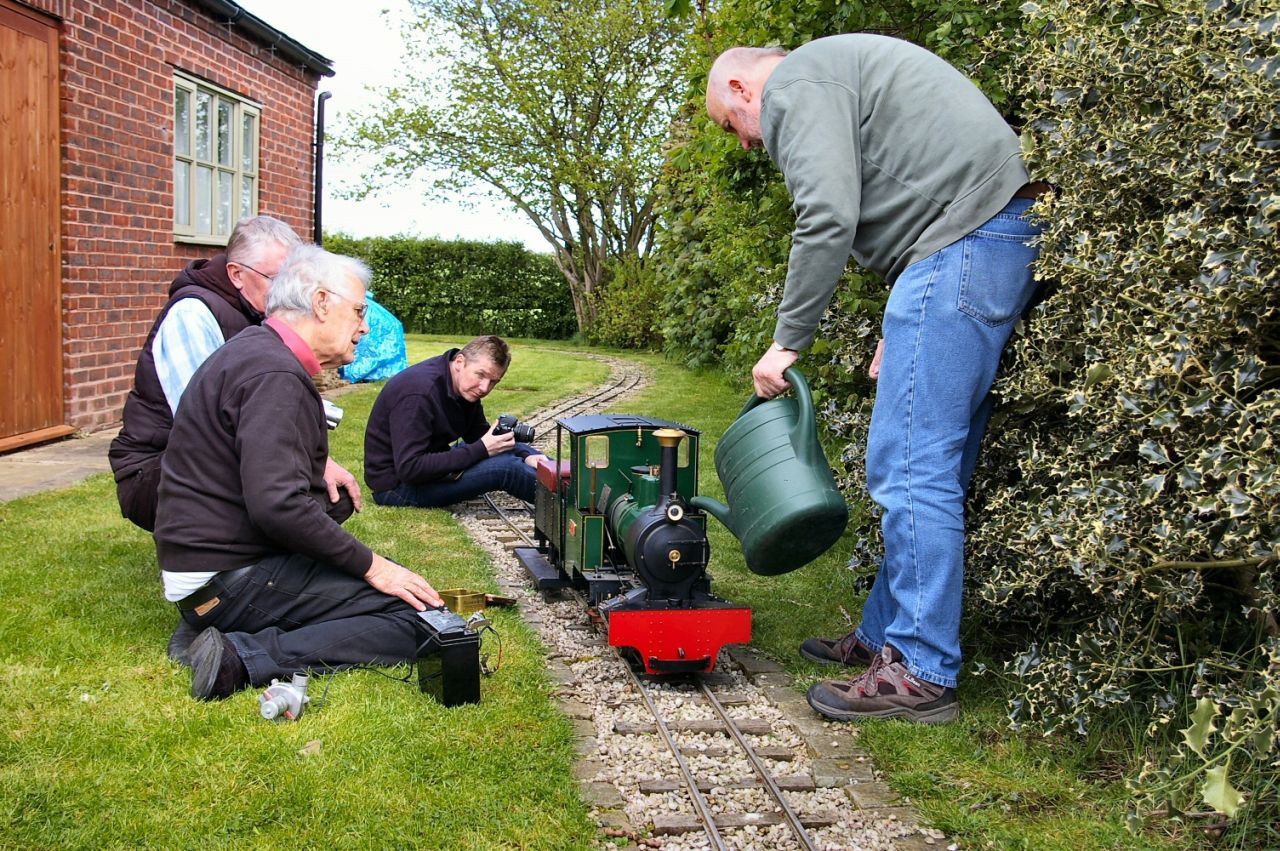
Chris Walker, Peter Ainley, David Prime and David Smith attending to "Mena"
Photos and text Bob Barnard
Bob Barnard is to give a talk to the North West branch of the Stephenson Locomotive Society on Saturday 18th February 2012 at 14.00.
The talk is entitled "The Lynton & Barnstaple Then and Now", and aims to cover the history of the line, what has survived and what hasn't since 1935, and the recent revival of the line, including future plans.
The SLS meetings are held at the Friends Meeting House, Mount Street, Manchester, and all visitors are welcome.
Anyone in the area with an interest in the L&B is encouraged to attend.
North West Area Group Report 2011
Thanks are due to Peter Ainley, John Berry, Stephen Fletcher and David and James Prime, who helped man the stand during the weekend.
The NW Group has attended four shows during 2011, at Preston, Dinas (WHR), Lytham St Annes and Wigan. Cumbria-based member John Berry has also given two lectures on the L&B to the Permanent Way Institution. In the course of all these events, we seem to have sold twice the amount of goods as in past years, and spread the word about the L&B's plans for expansion and for new/rebuilt rolling stock.
Plans for 2012 currently include a lecture by Bob Barnard to the Stephenson Locomotive Society in Manchester in February, the Preston Show in early March, and Wigan once again at its new date in June.
We are finding it beneficial to attend different venues, to get our message across to a wider group of people.
Bob Barnard
North West Area Group to attend Welsh Highland Superpower Event 10/11 Sept 2011
A brief (?) report on our weekend.
We had a very good time, with a stand in Dinas Goods shed, which contained a refreshment room facility, as well as Jonathan Clay prints, Nigel Bird Books, WHR(P) 590 Fund, and FR/WHR book/video stand.
For some reason, unexplained, there was a continuous showing of The Titfield Thunderbolt, and a small model of a scene from the film. No one ever seemed to man the stand, and hardly anyone looked at it for any length of time.
Outside, Lilla and Britomart were giving (free/donation) cab rides up and down the yard. The driver who is bringing Lilla down to Woody Bay at the end of the month was there, and is really looking forward to the trip.
NWAG members Peter Ainley and Gerry Crocombe helped out on the L&B stand on Saturday, and John Berry on Sunday. My wife Sue held the fort each hour or so, when trains came through and the chaps went to watch although Sue did manage to see Lyd!
We had a visit from John Prideaux on Saturday, who stopped for quite a long chat. We were also visited by various other FR/WHR notables over the weekend.
We figured that only a relatively small proportion of the (large number of) people stopped at Dinas as there was a beer festival at Waunfawr, so lunch breaks may have happened there. But mainly, as the WHR is such a long trip, anyone wanting to do the lot has to stay on the train.
Having said that, the shed had a steady stream of visitors, but it was quite possible for a visitor to Dinas who did not want a snack or a drink to not realise there were stands inside. The plan had been to open the doors at the "yard" end of the shed, with Lilla etc. right outside, which would have increased our visibility, but it was too wet/windy.
First thing on Sunday morning, I drove down to Boston Lodge, and saw Coach 17 underframe. It is seriously big! The air cylinders and one vacuum cylinder were fitted, but not linked to the cross-shafts yet - a pity as I wanted to see how the slotted links work. The airpipes are fitted, but not the vacuum pipe. There were two magnificent polished (angle ground) coupler hooks on the bench, and apparently they are puzzling over how to drill them in just the right place, to ensure that the tensioning device works correctly.
I stopped at Porthmadog to get a first look at Lyd and take a few photos. It then set off with its train just as I was going back to the car so I watched it cross Britannia Bridge.
The timetable went to pot both days (historically accurate, you might say, as that was exactly what the pre-war WHR suffered from!). They were doing a "King of the Hill" competition, with timings for various locos being recorded. But, a loco that is not performing at its peak cannot manage to keep to time with a decent load over the route. The Statfold Mallet messed everything up on Sat morning, but seemed to be running OK later in the day, but by then everything was a good 20min late. Something messed it up on Sun morning as well (the Mallet again? I am not sure), and Lyd added to the difficulties in the afternoon when she was withdrawn
Some trains, including Lyd's train (3 coaches + toastrack) were very lightly loaded. I suppose you could say everyone wanted to SEE Lyd, but not necessarily to travel for 2 or 4 hours in vintage coaches behind it. L&B Member Dave Horsfall from Peterborough (he often guards at WB) rode on the train (1st Class) and enjoyed it. Lyd had problems with contaminated fuel clogging the filter at Caernarfon. After cleaning the filter, it became clogged again at Dinas and Paul Lewin - who was driving - failed the loco which was then taken out of service and the return working cancelled. Which was fine for John and I, as we could photograph Lyd shunting its train into the carriage shed at Dinas.
John Harvey from the HMRS Livery Register was there to see Lyd and also to haunt me about my overdue L&B section for the Livery Register. He approved of Lyd's colour, saying it is a good match to the later LSWR loco green, which was the current standard SR colour in 1924/5. He says, Lew was not an "experimental" green, but the standard at the time. But Sir Herbert Walker (or someone) asked Maunsell if the engines could be made a bit less insipid, so the colour was darkened. It is possible that the LSWR colour faded in an unattractive manner.
Against the light, or in poor light, the green appears quite dull/dark. But then, when the light hits it just right, the whole engine looks more of a grass or apple green and very attractive.
The tank front steps are a masterpiece of painting - they have curved lining so that they "disappear" when fitted.
Regards
Bob Barnard
At the kind invitation of our friends at the FR/WHR, the North West Area Group of the L&B will have a Display and Sales Stand in Dinas Goods Shed during the WHR Superpower Weekend on 10/11 September 2011. Full details of the Superpower Event can be found by clicking on the image below.

L&B members attending the event, and any others with an interest in the L&B (membership forms will be available!), are encouraged to seek out our stand and have a chat.
STOP PRESS 07/09/11 - Lyd has today left the Boston Lodge paintshop - now resplendant in Southern Railway livery ready for this event - see HERE
Bob Barnard
Exmoor's Award Winning Railway


L&B News

You search online - others will donate!
Join the 100 Club

Members

Latest Update:
18th October 2022
Member

We are listed on


Corporate Supporters - Where to Stay